
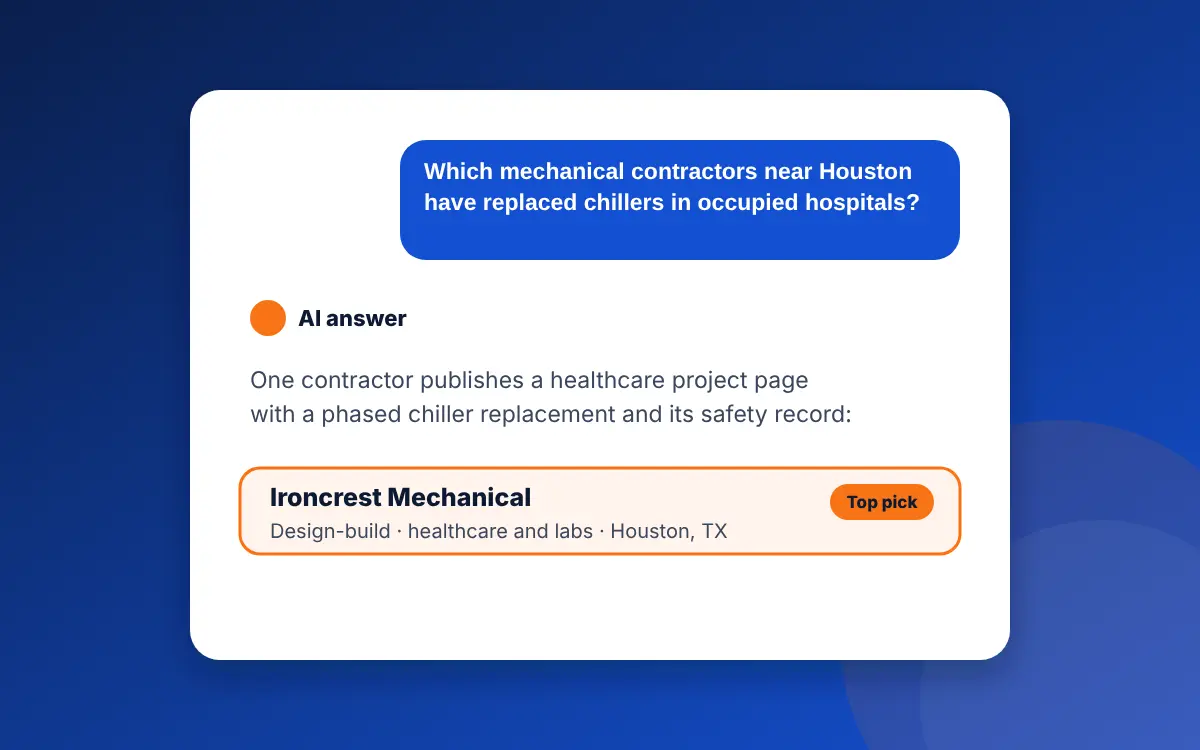
Commercial GEO (generative engine optimization for commercial contractors) is the work of making a contractor's capabilities, project history, safety record and service area easy for AI search tools such as ChatGPT, Perplexity, Gemini and Google AI Overviews to find and repeat accurately when a business buyer researches contractors or subcontractors. It does not replace bids or prequalification. It helps you get onto the list that is invited to bid.
What the data says, and what it doesn't
Here is the picture as of October 2026. We could not find published research that measures how procurement officers or facility managers use ChatGPT or similar tools to choose construction contractors. If you see an exact percentage of facility managers "using AI to pick contractors", ask for the source before you repeat it.
There is solid data on business buying in general. Forrester's State of Business Buying release from December 4, 2024 reported that almost 95% of B2B buyers expected to use generative AI to support their decision and purchase process within the next 12 months (Forrester). That survey covers business purchases broadly, not construction in particular, so treat it as a direction of travel rather than a measure of your market.
Our view: buyers who already use AI tools for other purchases are likely to use them to research contractors too. Preparing now costs little, because the same pages help with Google, with referrals who check you out, and with prequalification reviewers.
Where search fits in a commercial tender
A typical commercial or institutional purchase moves through these stages. The details vary by owner and by public or private work.
- Need. A plant reaches end of life, a tenant signs, a capital budget is approved.
- Longlist. The facility team, owner's rep or general contractor gathers names. This is where search and AI tools come in, alongside past vendors and referrals.
- Prequalification. Questionnaires, safety records, insurance and bonding letters. Some owners use platforms such as ISNetworld or Avetta for this step. Federal work requires registration in SAM.gov.
- Invitation to bid and the bid itself.
- Award, decided on price, schedule, qualifications and trust.
Generative search matters most at stage 2, and again when someone checks a name they were given. If your company is missing or described vaguely at that point, you may never see the invitation.
What AI tools need to find about your company
An AI answer about commercial contractors is assembled from text the tool can find and trust. Give it these facts in plain words on your own site, and keep them identical everywhere else your company is listed.
- A capabilities page in HTML, not only a PDF: self-perform scope, sectors, delivery methods, project size range, licenses by state and class, and your NAICS codes (238220 for plumbing, heating and air conditioning contractors).
- Sector pages for the markets you want more of, such as healthcare, education, industrial or data centers, each linking to matching projects.
- Project pages that state the building type, size, city, systems, constraints and schedule. Name the client only with written permission.
- Safety and capacity facts you are willing to publish: EMR, OSHA recordable rate, bonding capacity. If you won't publish them, say they are available on request.
- Matching listings on Google Business Profile, Bing Places, LinkedIn, SAM.gov if you do federal work, state vendor portals and trade associations such as MCAA, SMACNA, ABC or AGC.
For a page-by-page breakdown for mechanical contractors, see SEO and AI search for commercial mechanical and HVAC enterprises.
Write for the questions buyers ask
Commercial buyers search with precise terms. They type the system, the building type and the constraint: "phased chiller replacement occupied hospital", not "HVAC company". Headings that use that vocabulary give AI tools a block of text that answers the question directly. Some examples:
- "How we replace central plant equipment while the building stays open"
- "Our self-perform scope on design-build mechanical packages"
- "Service agreement response times for healthcare facilities"
Open each section with a one or two sentence answer, then the detail. That format also suits Google's featured snippets.
Test what AI tools say about you
Once a month, ask ChatGPT, Perplexity, Gemini and Google the questions your buyers would ask. Use your sector, your city and a real job type. Write down whether your company appears, what is said about it, and which sources are cited. When a competitor is named and you aren't, open the sources cited for them. That shows you what to publish next.
Answers change from one day to the next and from one user to another, so look for patterns over several months, not single results.
What to skip
- Anyone who promises a guaranteed spot in ChatGPT answers. Nobody controls that.
- Pages stuffed with city names and keywords. They read badly to buyers and to search engines.
- Invented case studies or numbers. A prequalification reviewer will ask for the documents.
How long it takes
New pages usually take weeks to months to be indexed and trusted, and commercial sales cycles run for months on top of that. Plan on judging results over two or three quarters. Track bid invitations and inbound inquiries from new names, not only phone calls.
Common questions
What is commercial GEO?
Commercial GEO is generative engine optimization for contractors who sell to businesses and institutions. It makes your capabilities, projects, safety record and service area easy for AI search tools to find and repeat accurately when a buyer researches contractors.
Do procurement officers use ChatGPT to choose contractors?
We have not found reliable published data on that for construction. Forrester reported in December 2024 that almost 95% of B2B buyers expected to use generative AI in their purchase decisions within a year, but that survey covers business buying in general. Formal bids and prequalification still decide awards.
Does AI search matter for public tenders?
Public tenders are awarded through formal procurement rules, so AI search will not win one for you. It can help at the research stage, when an owner or general contractor looks for qualified subcontractors to invite or checks a company it was given.
Should our capabilities statement be a PDF or a web page?
Both. Keep the PDF for bid packages and put the same facts on a web page with clear headings. The page is easier for search engines and AI tools to read and quote, and easier for you to keep current.
How do I check whether AI tools mention my company?
Each month, ask ChatGPT, Perplexity, Gemini and Google the questions your buyers ask, using your sector, city and job type. Record whether you appear and which sources are cited. Look for patterns over several months, because single answers vary.
See what buyers and AI tools find when they look you up
The free audit scores your site for Google and AI search and lists the fixes that matter most, ranked by impact.
Get my free audit