
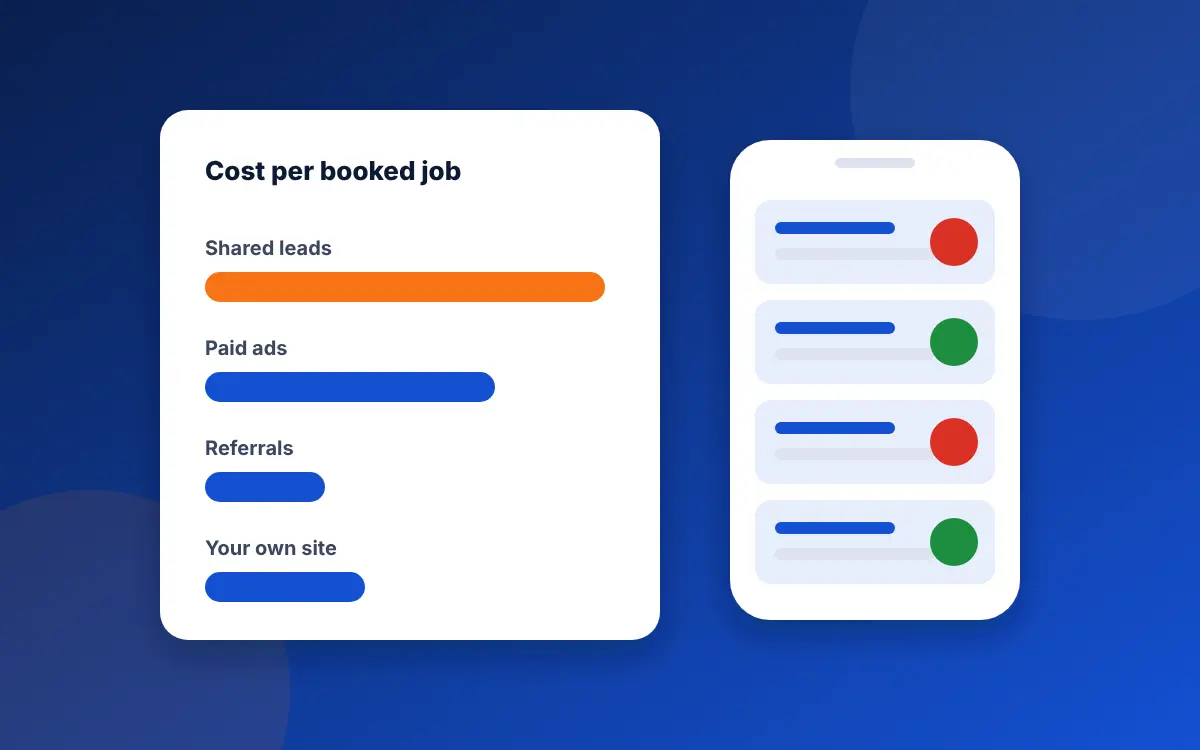
Angi leads are worth it when your real cost per booked job, meaning total Angi spend divided by jobs won, sits comfortably inside your profit on those jobs. Angi matches each homeowner request with up to five pros, charges per lead whether you win or not, and credits only specific bad leads, so fast follow-up decides most of the math.
How Angi charges contractors in 2026
Angi, which also owns HomeAdvisor, sells leads to home service pros. A homeowner describes a project, and Angi sends it to matching pros in that area. Angi's help center says "each time a homeowner submits a project request, we will match them with no more than five pros."
On price, Angi says "lead fees change based on task, homeowner location, and demand for the work". It doesn't publish a fee table, so the only reliable figures are the ones on your own invoices. Pros can buy leads as they come or sign up for a subscription, where leads are billed monthly against a budget set for the year in the contract.
Three things follow from that setup. You compete with up to four other companies for most leads. You pay whether or not you win the job. And the price per lead goes up in the trades and towns where work is most in demand, which is often where competition for each lead is fiercest too.
What you can and can't get credited
Angi does give credits for some bad leads, but the list is narrow. From its lead credit guidelines:
| Situation | Credit possible? |
|---|---|
| Phone number disconnected, not in service or not the homeowner's | Yes |
| Project outside the ZIP codes in your profile | Yes |
| Project type doesn't match the services in your profile | Yes |
| Charged twice for the same homeowner within 45 days | Yes |
| Charged while your leads were paused | Yes |
| Homeowner never answers or returns your calls | No |
| Homeowner hired another pro before you reached them | No |
| Homeowner decided not to go ahead | No |
| Homeowner is only gathering quotes | No |
| You quoted and lost the job | No |
Angi says the second group is "accounted for in our lead pricing". To qualify for a credit, the lead must be less than 45 days old, you should have tried to call within 24 hours of receiving it, and your account must be in good standing. Credits are reviewed within five business days and expire if unused after six months. If you're on an annual subscription, you can report bad leads but won't get credits for them.
In plain terms: the leads that cost you most, the ghosts and the price shoppers, are the ones you pay for regardless.
Work out your real cost per job
The price per lead tells you very little. What matters is what you pay for each job you win. You need three numbers from the last three to six months:
- Total spent on Angi, including any membership or subscription fees, minus credits received.
- Number of jobs booked from Angi leads.
- Average gross profit on those jobs, after materials and labor.
Divide the first number by the second. That's your real cost per booked job. Compare it with the third.
Suppose, as an example, you paid $1,800 for 30 leads and booked 5 jobs. Your cost per booked job is $360. If those jobs average $600 in gross profit, Angi left you $240 per job before your time, which may be fine for filling slow weeks. If they average $300 in profit, you lost money on every one. The same lead price can be a good deal for a roofer and a bad one for a handyman.
Then add the hidden cost: time. Count the hours spent calling, texting and quoting leads that never booked. If a lead takes 20 minutes to chase and most don't book, that's hours a week of office or owner time.
When Angi is worth it
- You're new or rebuilding and need calls this month while you build reviews and a search presence.
- Your jobs carry high profit, so one win covers many lost leads.
- You answer within minutes. Angi itself says quick replies improve your odds. With up to five pros on a lead, the first to reach the homeowner gets the first conversation, and sometimes the only one.
- You have a sales process: scripts, follow-up texts, and someone whose job it is to call leads back.
- You use it to fill gaps, such as a slow season, rather than as your main source of work.
When it isn't
- Your cost per booked job is close to or above your profit per job.
- You can't call back within the hour because you're on a roof or under a house all day.
- You win mostly on quality and can't compete on price with four other quotes.
- Angi has become most of your work, so a price rise or a change in matching rules would hit you hard.
That last one deserves weight. When a single platform sets both the price of your leads and the rules for who gets them, it controls your margin. Owning some of your own lead flow, through search, your Google profile and referrals, is protection as much as growth.
A note on HomeAdvisor's FTC case
In 2023 the Federal Trade Commission finalized an order requiring HomeAdvisor to pay up to $7.2 million. The FTC alleged that HomeAdvisor made "false, misleading, or unsubstantiated claims about the quality and source of the leads", including that pros would only get leads matching their services and area, and that it told pros its leads turned into jobs "at rates much higher than it can substantiate". The case ended in a consent order rather than a trial. The order bars false or misleading claims about leads, including that they come from people "ready to hire". It's a reason to judge any lead service by your own numbers rather than its sales pitch.
How Angi compares with other ways to get calls
| Channel | How you pay | Shared with competitors? | Keeps working if you stop paying? |
|---|---|---|---|
| Angi | Per lead, or a yearly subscription | Up to five pros per request | No |
| Google Local Services Ads | Per lead | The homeowner contacts you directly, though they may contact others too | No |
| Google Ads | Per click | No, the click comes to your site | No |
| SEO and Google Business Profile | Time or a monthly fee, nothing per lead | No, the caller found you | Yes, for a long time |
| Referrals and repeat customers | Good work, and a reason to remember you | Rarely | Yes |
For reference, LocaliQ's 2026 benchmarks put the average cost per lead from Google search ads in the home and home improvement category at $90.92, so paid clicks aren't cheap either. We break down all three paid options in SEO vs Google Ads vs Local Services Ads.
Getting more from Angi if you stay
- Tighten your ZIP codes and service list to the work you want and can reach. Every mismatch is money spent, and only clear mismatches get credited.
- Call within minutes, then text. Set up alerts so leads reach whoever is free, not just the owner's phone.
- Request credits for every eligible lead within the 45-day window, and keep a note of call attempts.
- Track each lead to a result in a simple spreadsheet: booked, quoted and lost, never reached.
- Recheck your cost per booked job every quarter, and set a number at which you cut spend.
Cutting back without emptying your schedule
Dropping Angi overnight is how contractors end up with a quiet month. Build your own lead flow first, then reduce Angi spend as direct calls grow. Our guide to getting calls that are only yours lays out a six-month switch-over plan, and is SEO worth it for contractors shows how to work out whether search can replace the leads you buy.
Common questions
Are Angi leads worth it?
They're worth it when your real cost per booked job is well below your profit per job. Work it out by dividing your total Angi spend by the number of jobs you won from Angi leads. Fast follow-up, tight service filters and high-profit jobs make the numbers work; slow callbacks and low-margin jobs usually don't.
How many contractors get the same Angi lead?
Angi's help center says each homeowner request is matched with no more than five pros. That means you're usually competing with other companies for the same job, which is why calling back within minutes matters.
How much do Angi leads cost?
Angi doesn't publish a price list. It says lead fees change based on the task, the homeowner's location and demand for the work. Check the fees on your own invoices, and judge them by cost per booked job, not cost per lead.
Can I get a refund for a bad Angi lead?
You can request a credit for specific problems: a wrong or disconnected number, a project outside your ZIP codes or services, a duplicate charge within 45 days, or a charge while paused. Angi doesn't credit leads where the homeowner never answers, hires someone else or is only collecting quotes.
Is Angi the same as HomeAdvisor?
Angi owns HomeAdvisor, and both sell leads to home service pros. In 2023 the FTC finalized an order requiring HomeAdvisor to pay up to $7.2 million over alleged misleading claims about its leads, and barring false claims such as leads coming from people ready to hire.
What is a good alternative to Angi for contractors?
The main alternatives are Google Local Services Ads and Google Ads for fast calls, and SEO with a strong Google Business Profile for calls you don't pay for per lead. Most contractors do best building their own search presence while keeping a paid channel until direct calls grow.
Sources
- Angi Help Center, Opportunities and leads: frequently asked questions (checked October 29, 2026)
- Angi Help Center, How to request a lead credit (checked October 29, 2026)
- Federal Trade Commission, FTC order requires HomeAdvisor to pay up to $7.2 million, January 23, 2023
- Federal Trade Commission, FTC approves final order against HomeAdvisor, April 21, 2023
- LocaliQ, Search advertising benchmarks, updated June 1, 2026
Angi's fees, matching rules and credit policy change from time to time. Check the current terms in your own account.
See how many calls your own site could bring in
The free audit shows what stops Google, Maps and AI tools from sending homeowners straight to you, so fewer calls arrive with a lead fee attached.
Get my free audit