
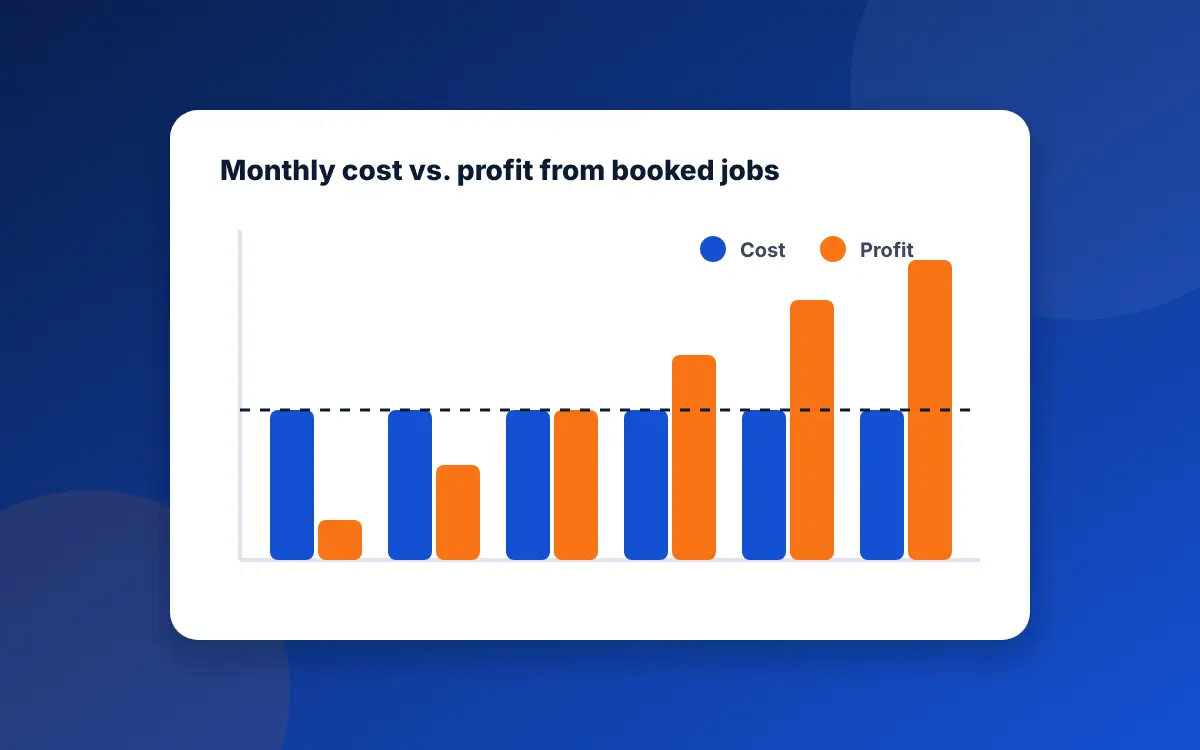
SEO is worth it for most contractors who serve one area and earn a healthy profit per job, because a few extra booked jobs a month usually cover the fee. It is a poor bet if you need calls this week or your schedule is already full, and a bad one if the agency can't say what it will change.
When is SEO worth it for a home service business?
SEO pays when three conditions hold at the same time: people in your area search for the work you do, you have room on the schedule for more of it, and each job leaves enough profit that a handful of extra jobs covers the monthly cost. Most plumbers, HVAC companies, electricians and remodelers meet all of them. Homeowners search for "water heater replacement", "AC repair near me" or "panel upgrade cost" every day, and they call whoever looks safest on the first screen.
It also pays because the work keeps working. A service page that ranks for "tankless water heater install" in your town keeps bringing calls in the months after it's written. A paid click is gone the moment you stop paying for it.
Signs SEO will probably pay for you
- You serve a defined area and want more of the jobs you already do well.
- Your average job brings in a few hundred dollars of gross profit or more. Replacement work, installs and remodels clear this easily.
- You have a crew or tech with open hours, or you plan to hire.
- You're paying for shared leads and losing most of them to cheaper quotes.
- Your website exists but barely shows up when you search for your own services.
Signs it won't pay yet
- You need the phone to ring this week. SEO is too slow for that; paid ads or a lead platform are faster.
- You're booked out for weeks and turning work away. Fix capacity first.
- You plan to sell or close the business within a year.
- The only offer on the table is a long contract with no named deliverables.
How do you work out if SEO will pay for your business?
Skip the agency's projections and do the sum yourself. You need two numbers from your own books: the average gross profit on a job, and the monthly cost of the SEO you're considering. Divide the cost by the profit per job and you have the number of extra jobs a month SEO must bring in to break even.
A worked example (made-up numbers, swap in yours). Suppose an HVAC company's average repair ticket is $450 and the gross profit after parts and labor is $250. An SEO plan costs $1,000 a month. Break-even is $1,000 divided by $250, which is four extra repair calls a month. If one of those calls in ten turns into a system replacement, the payback improves a lot, because a replacement job carries far more profit than a repair.
Then ask the honest question: is four extra booked jobs a month realistic for your town and your starting point? If your site barely ranks today and competitors have years of reviews, it may take months to get there. If your site is close to the first page already, it may come faster.
| Monthly SEO cost | Profit per job $150 | Profit per job $300 | Profit per job $1,000 |
|---|---|---|---|
| $300 | 2 jobs | 1 job | Under 1 job |
| $1,000 | 7 jobs | 4 jobs | 1 job |
| $2,500 | 17 jobs | 9 jobs | 3 jobs |
| $5,000 | 34 jobs | 17 jobs | 5 jobs |
Extra jobs needed each month to break even, rounded up. The table makes one thing obvious: a remodeler with $1,000 of profit per job can justify a much bigger budget than a handyman with $150 per visit. Repeat customers and referrals make every new customer worth more than the first ticket, so this sum understates the return for trades with maintenance plans.
What does SEO cost compared with ads and lead platforms?
SEO is one of three ways a contractor can buy visibility, and the honest comparison is cost per booked job, not cost per click.
| Channel | How you pay | Speed | What happens when you stop paying |
|---|---|---|---|
| Google Ads (search) | Per click. LocaliQ's 2026 benchmarks put the Home and Home Improvement average at $8.33 a click and $90.92 per lead. | Days | Calls stop |
| Local Services Ads | Per lead (a call or message through the ad), set by Google | Days to weeks, after screening | Calls stop |
| Lead platforms (Angi, Thumbtack and similar) | Per lead or per contact, often shared with other pros | Days | Leads stop |
| SEO (Google, Maps, AI answers) | Monthly fee or your own time | Months | Rankings fade slowly; pages and reviews stay yours |
Those ad figures are averages across thousands of campaigns, and your city can cost far more or far less. Still, the gap explains why contractors stick with SEO: a page that brings ten calls a month does it without a per-click bill.
On agency pricing, published contractor SEO quotes run from about $1,000 to $5,000 a month. Our SEO cost guide lists the sources and what drives the price. Realo’s Monthly care plan is $600 a month after a free audit, and the pricing page shows exactly what that covers.
How long does SEO take to pay back?
Expect months, not weeks. Google's own advice on hiring an SEO tells you to ask any provider what results to expect and in what timeframe, and states plainly that no one can guarantee a number one ranking on Google.
In practice, the timeline depends on where you start:
- Quick fixes such as a wrong primary category on your Google Business Profile, missing service areas, or a site that blocks crawlers can change things within weeks of being fixed and recrawled.
- New service and town pages usually need a few months to be crawled, tested by Google and settle into a position.
- Competitive head terms like "plumber Dallas" take the longest, often a year or more, because the businesses ranking there have years of reviews and links.
That's why a good plan starts with the fixes that can pay quickly, and why you should keep paid channels running until direct calls clearly rise. Read SEO vs Google Ads vs Local Services Ads for how to run them side by side.
Is local SEO dead now that AI answers the questions?
No, though it has changed. Pew Research Center tracked the browsing of 900 US adults in March 2025 and found that people clicked a regular search result in 8% of visits when Google showed an AI summary, against 15% when it didn't. Clicks on links inside the summary itself happened in about 1% of visits. So AI summaries do take clicks away from plain informational pages.
Local searches for a service are a different case. Someone with a leaking water heater needs a business, and Google still shows the map pack with phone numbers and reviews for those searches. AI assistants such as ChatGPT and Gemini, when asked for a local contractor, name businesses they can find and verify on the web: in maps data, directories, reviews and the business's own site. The same groundwork that makes you rank on Google makes you easier for an AI tool to recommend. We explain the sources each tool reads in how to get recommended by ChatGPT.
What has died is thin SEO: pages stuffed with "best plumber in [city]" written for a crawler, with nothing a homeowner can use. Pages that answer real customer questions, with prices and service areas on them, are what Google and AI tools now reward.
Are SEO agencies worth it, or can you do it yourself?
You can do a lot of it yourself, and some of it you should do yourself no matter who you hire. The free, owner-only jobs are your Google Business Profile, your Bing Places listing, asking every customer for a review and replying to reviews. Our Google Business Profile checklist walks through the settings in order.
An agency earns its fee on the jobs that take skill or hours you don't have: writing service and town pages that rank, fixing technical problems, adding structured data, tracking which pages bring calls and keeping up with Google and AI search changes. If you have an evening a week and enjoy it, try the free work first for three months. If you'd rather spend that evening quoting jobs, the math above tells you what you can afford to pay someone.
Do SEO companies really work, or is it a scam?
Many SEO companies do honest work. The bad ones give the whole trade its reputation, and Google publishes a list of warning signs. In its guide to hiring an SEO, Google tells business owners to be wary of firms that email out of the blue, and to find someone else if a firm guarantees first place in search results. It also warns against SEOs that claim a "special relationship" with Google, and says you should never have to link to an SEO.
Add these from the contractor side:
- A long contract with no list of what gets done each month.
- Reports full of "impressions" and rankings for phrases nobody searches, with no calls or form fills.
- You don't own your website, your Google Business Profile or your content if you leave.
- Nobody can tell you who does the work.
Before you sign, ask the questions in our guide to choosing an SEO company.
What we found when we audited 20 contractor websites
On October 18, 2026 we ran Realo's audit on the websites of 20 HVAC, plumbing and roofing companies around Tulsa. The average score was 54 out of 100. Technical health was the strongest area at 71, and conversion was the weakest at 40.
That pattern matters for this question. Most of those sites weren't failing SEO because of broken code. They were losing calls on things like these:
- 20 of 20 had no estimator, calculator or diagnostic tool.
- 18 of 20 listed no prices in structured data.
- 19 of 20 hadn't marked up their service area with real place names.
- 6 of 20 scored zero for showing proof, such as a license or reviews, on the first phone screen.
None of those cost much to fix. When a contractor tells us SEO didn't work for them, this is often the reason: the money went into rankings while the page that greets the visitor never gave them a reason to call. The full results are in the Tulsa audit study.
A 90-day test before you commit to a year
If you're unsure, run SEO as a test with a clear finish line.
- Week 1: start asking every caller "how did you find us?" and write the answer down. Without this, nobody can prove anything later.
- Weeks 1 to 4: fix your Google Business Profile, get your name, address and phone identical everywhere, and make sure your three most profitable services each have their own page.
- Weeks 4 to 12: add pages for your main towns and the questions customers ask on the phone, with price ranges where you can give them.
- Day 90: count calls from Google search, Maps and AI tools against the 90 days before. Agree with any agency, before you start, what number counts as a pass.
Ninety days won't show the full return of SEO, but it will show whether the work is moving the right numbers and whether the people doing it are straight with you.
Common questions
Is SEO worth it for a small business?
SEO is worth it for a small business that serves a defined area and earns enough profit per job that a few extra jobs a month cover the cost. Divide the monthly SEO cost by your gross profit per job to see how many extra jobs you need to break even.
Is local SEO still worth it with AI search?
Yes. Google still shows the map pack with phone numbers and reviews for local service searches, and AI assistants recommend businesses they can find and verify on the web. A complete Business Profile and clear service pages help with both.
How long does SEO take to work for a contractor?
Quick fixes such as a wrong Business Profile category can help within weeks. New service and town pages usually take a few months. Competitive city-wide terms can take a year or more. No one can guarantee a ranking or a date.
Can I do SEO for my contracting business myself?
Yes, much of it. Your Google Business Profile, Bing Places listing, review requests and review replies are free and best done by the owner. Writing pages and technical fixes take more skill and time, which is where paid help earns its fee.
How do I know if an SEO company is a scam?
Google warns against firms that guarantee first place, claim a special relationship with Google or contact you out of the blue. Also walk away from long contracts with no listed deliverables, and from any deal where you don't own your site and profile.
Is SEO better than Google Ads for contractors?
They do different jobs. Google Ads brings calls within days but stops when you stop paying, and LocaliQ's 2026 benchmarks put the average home services lead at about $91. SEO is slower but the pages keep working. Most contractors run ads while SEO builds, then cut ad spend as direct calls grow.
Sources
- Google Search Central, Do you need an SEO? (checked October 29, 2026)
- Google Business Profile Help, Tips to improve your local ranking on Google (checked October 29, 2026)
- Pew Research Center, Google users are less likely to click on links when an AI summary appears in the results, July 22, 2025
- LocaliQ, Search advertising benchmarks, updated June 1, 2026
- Google Local Services Help, Getting started with Local Services Ads (checked October 29, 2026)
- Realo, audit of 20 Tulsa contractor websites, October 18, 2026
See what SEO could take off your ad bill
The free audit shows which pages and profile fixes could bring in calls without a per-lead fee, ranked by impact, so you can judge whether SEO is worth it before you spend anything.
Get my free audit