
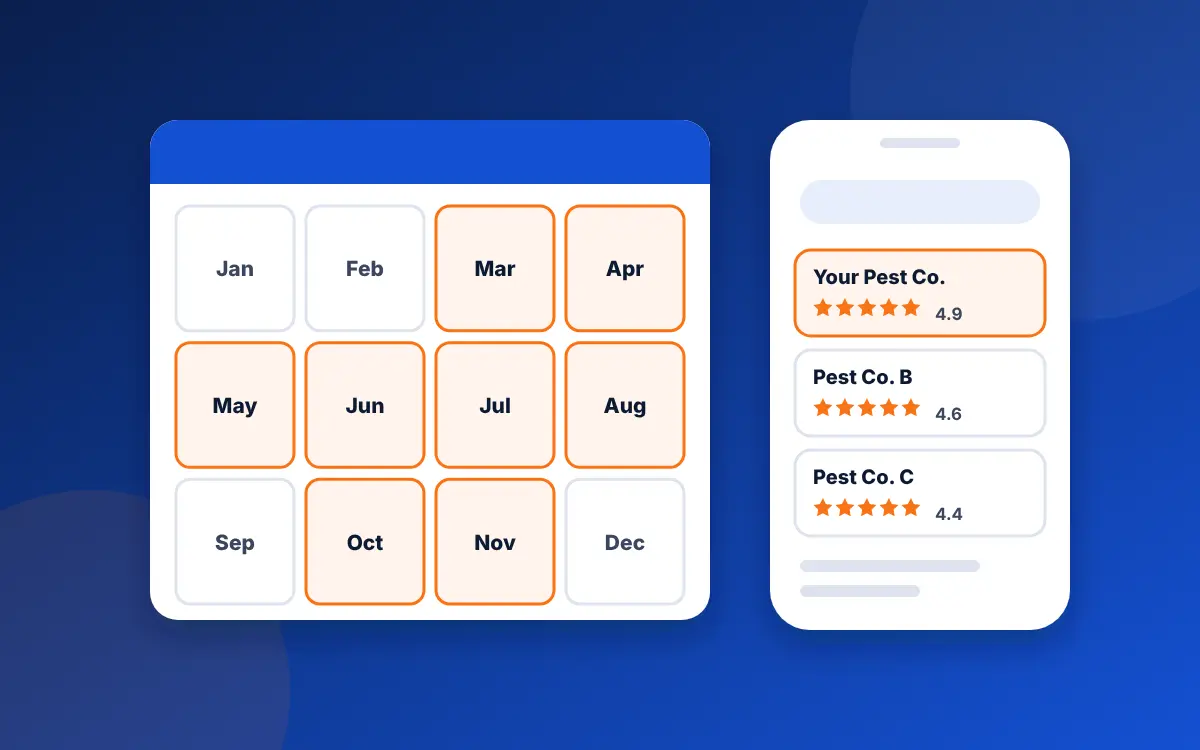
The cheapest pest control leads come from current plan customers, their neighbors, referral partners and a strong Google Business Profile. Paid sources such as Local Services Ads and search ads help at each seasonal peak. The leads that pay most are the ones that turn into recurring plans, so judge every source by plans signed and kept, not by calls.
Where pest control leads come from, and what each one costs
| Source | How you pay | Best time | Watch out for |
|---|---|---|---|
| Current plan customers | Nothing extra; you already earned them | Every visit | Plans that lapse because nobody calls before renewal |
| Neighbors of current customers | Door hangers, yard signs, your time | The day you treat a home | Treating one house and never telling the street |
| Referral partners | Time spent building the relationship | All year, busiest in home-buying season | Slow reports that make the agent look bad to their client |
| Google Business Profile and map pack | Free | All year, strongest at each pest peak | Wrong category, no services listed, no recent photos |
| Local Services Ads | Per lead, price set by Google | Seasonal peaks | Missed calls during your listed hours can still count as leads |
| Google search ads | Per click | Termite and rodent pushes | Sending clicks to the home page instead of a pest page |
| Lead platforms | Per lead, often shared | Gaps in the route | Price shoppers who want one visit and no plan |
| Your website and AI search | Build cost and upkeep, no per-call fee | Must be ready before each season | One thin "pest control services" page for every pest |
Measure plans, not calls
A one-time treatment and a quarterly plan can start with the same phone call. For each lead source, track three numbers: calls, plans signed and plans still active a year later. A source with expensive leads that turn into long plans can beat a cheap source full of one-visit price shoppers. Our lead cost calculator compares every source at once; for pest control, enter plans signed as jobs booked and a first-year plan value as the job price.
Plan your marketing around pest seasons
Different pests peak at different times, and homeowners search for the pest, not for "pest control". The National Pest Management Association says spring is peak termite season, when winged termites leave mature colonies to start new ones, and that termites cause an estimated $6.8 billion in property damage a year. It also says rodents invade millions of homes each winter. Your pages for each pest need to be live before its season starts.
| When | What to do |
|---|---|
| Late winter | Refresh termite pages: swarmer signs, inspections, treatment options and your warranty terms. Contact real estate agents and home inspectors before home-buying season. |
| Spring | Termite swarms and ants. Turn on ads for termite inspections where you have capacity. Offer a plan on every one-time visit. |
| Summer | Mosquitoes, ants, wasps and other stinging insects, depending on your region. Ask every customer for a review the day of the visit. |
| Fall | Refresh rodent and exclusion pages before the cold. Call plan members about adding rodent work. |
| Winter | Rodent calls. Count which sources signed plans this year. Plan next year's pages. |
Adjust for your climate and the pests that matter where you work. A company on the Gulf Coast and one in the upper Midwest see different calendars.
Turn one-time calls into plans
The visit is where the plan gets sold. Make it easy for the homeowner to say yes:
- Put your plan prices on your website, with what each visit includes and which pests are covered. A homeowner comparing companies at night can't call you to ask.
- Give the technician a written plan offer to leave at every one-time visit.
- Credit part of the first treatment toward the plan if they sign within a set number of days.
- Call plan members before renewal instead of waiting for them to cancel.
- Give the plan its own page, so plan questions on Google and in AI tools have an answer from you.
Answer safety questions honestly, without the word "safe"
Parents and pet owners want to know what you're spraying in their home. They search for it and they ask AI tools. Answer them, but watch your wording. Under EPA labeling rules, claims such as "safe", "harmless" or "nontoxic to humans and pets" are treated as false or misleading on pesticide labeling, even with the words "when used as directed". Your state may apply similar rules to advertising, so check with your state pesticide agency before you put those words on your site.
What you can say plainly:
- Which products you use, with a link to each label or safety data sheet.
- How long people and pets should stay off treated areas, as the label directs.
- What you do to reduce exposure, such as targeted baits, crack and crevice treatment or exclusion work.
- Your state license or certification number, and who on your team holds it.
Federal law requires certification to apply restricted use pesticides, and the EPA notes that many states require certification for all commercial pesticide use. Showing your number near the top of each page answers the trust question before the homeowner asks it.
Get your Google Business Profile right for pest control
Google says it ranks local results on relevance, distance and prominence, and that "more reviews and positive ratings can help your business's local ranking." It also says there's no way to pay for a better local ranking. For pest control companies:
- Primary category: "Pest control service" for most companies. Add secondary categories only for work your company does.
- Services: list general pest control, termite inspection and treatment, rodent control and exclusion, mosquito control, bed bugs and wildlife removal separately, with a short description of each you offer.
- Photos: real technicians, real trucks, real exclusion work. Add new ones every month.
- Reviews: ask every customer, by text, the same day. BrightLocal's 2024 survey of 1,141 US consumers found that 81% use Google to read local business reviews, and 71% wouldn't consider a business rated under three stars.
The full list is in our Business Profile checklist. If your profile doesn't show up at all, start with why your business isn't showing on Google Maps.
Build a page for each pest
Homeowners search "termite inspection near me", "mice in walls" or "how much does mosquito control cost". One general services page can't answer all of those. Pages worth writing, each on its own URL:
- Termite inspection and treatment: the signs, how you inspect, your treatment options, warranty and price range.
- Rodent control and exclusion: how you find entry points, what sealing them involves and how many visits it usually takes.
- Mosquito control: how often you treat, which months, and what homeowners can do between visits.
- Bed bugs: your treatment method, how to prepare and how many visits to expect.
- Plans and pricing: what each plan covers and costs.
- Real estate inspections: your wood-destroying insect report, turnaround time and how agents can book.
Give each page a short, direct answer at the top, then the detail. Our guide to service pages that rank shows the layout, and how to get recommended by ChatGPT covers the facts AI tools look for.
What we see on home service websites
We haven't audited pest control websites yet. When we audited 20 other home service websites around Tulsa in October 2026, the same gaps showed up across every trade: none had a calculator or estimator, 19 hadn't marked up their service area in the code search engines read, 18 listed no prices in that code, and 6 showed no proof such as a license or reviews on the first phone screen. Putting plan prices and a license number on the page fixes most of that. The full method is in the Tulsa audit study.
Use paid leads at the peaks
Local Services Ads
Pest control has its own Local Services Ads category. You pay per lead and appear at the top of pest searches with your rating and the Google Verified badge. Google's help page on how leads work says a missed call during your business hours can count as a lead if the caller stays on the line for more than 20 seconds, and follow-up contacts from the same customer within 15 days aren't charged again. Set your ad hours to when someone answers. Google is also moving Local Services Ads into Google Ads as a pay-per-lead Performance Max campaign, starting in August 2026 for some US advertisers, so download your reports before your account moves. We compare the options in SEO vs Google Ads vs Local Services Ads.
Google search ads
LocaliQ's 2026 benchmarks put the Home and Home Improvement category at an average of $8.33 a click and $90.92 per lead. That can pay off for a termite job or a signed plan, and rarely for a single general treatment. Point ads at the page for the pest, and run them where your routes already go.
Lead platforms
Platforms can fill gaps in a route, but the same request can go to several companies, and you pay either way. In 2023 the FTC finalized an order requiring HomeAdvisor to pay up to $7.2 million after alleging it misled service providers about the quality of its leads. Track plans signed per platform before spending more, and see how to get calls that are only yours.
Referral partners pest companies overlook
Real estate agents and home inspectors. Many home sales need a termite or wood-destroying insect inspection. Agents and inspectors want a company that reports fast and explains findings clearly. Be that company and they'll send you buyers who become plan customers.
Property managers. Rental homes and apartment complexes need regular service and quick response to tenant complaints. One manager can bring many doors.
A simple weekly routine
- Ask every customer for a review, by text, the same day.
- Post one real job photo with a sentence to your Business Profile.
- Log where every new call came from and whether it became a plan.
- Update one page on your site: a price, an FAQ answer, a town.
- Leave door hangers on the streets around this week's treatments.
Thirty minutes a week, every week, beats a scramble when the swarms start.
Compare your lead sources in two minutes
Enter spend, leads and booked jobs for each source and see which one pays. Free, and your numbers stay in your browser.
Common questions
How do pest control companies get more leads?
Start with sources that carry no fee per lead: current plan customers, their neighbors, real estate and property management partners, and a complete Google Business Profile with steady reviews. Build a page for each pest before its season, then use Local Services Ads and search ads at the peaks. Track plans signed for each source.
What is the best lead source for pest control?
The one with the lowest cost per plan signed and kept, which you only learn by tracking every call through to the plan. Referrals and neighbors of current customers usually cost least, because you don't pay for each lead.
How do I turn one-time pest customers into recurring plans?
Show plan prices and what each visit covers on your website, leave a written plan offer at every one-time visit, and credit part of the first treatment if they sign within a set time. Call members before renewal so plans don't lapse.
When should pest control companies start marketing for termite season?
In late winter. The NPMA describes spring as peak termite season, and new pages need time to be found and ranked. Refresh termite pages and contact real estate agents and home inspectors before home buying season.
Can I say my pest treatments are safe for kids and pets?
Be careful. EPA labeling rules treat claims such as safe, harmless or nontoxic to humans and pets as false or misleading on pesticide labeling, and your state may apply similar rules to ads. Instead, name the products you use, link the labels, give re-entry times and show your license number.
Are Local Services Ads worth it for pest control?
They can be. Pest control services is an eligible category and you pay per lead. Set ad hours to when someone answers, because missed calls during your hours can count as leads, and compare plans signed from these leads with your other sources.
Sources
- National Pest Management Association, Termite season is here: know the signs of an infestation, March 3, 2025
- National Pest Management Association, Nationwide polar vortex could bring in unwanted houseguests, January 22, 2026
- US Environmental Protection Agency, Certification standards for pesticide applicators
- Code of Federal Regulations, 40 CFR 156.10, labeling requirements
- Google Business Profile Help, Tips to improve your local ranking on Google
- Google Local Services Help, Getting started with Local Services Ads
- Google Local Services Help, How leads work
- Google Ads Help, Local Services Ads transition to Performance Max campaigns with pay-per-lead goals
- LocaliQ, Search advertising benchmarks, updated June 1, 2026
- BrightLocal, Local Consumer Review Survey 2024, March 6, 2024
- Federal Trade Commission, FTC approves final order against HomeAdvisor, April 2023
- Realo, audit of 20 Tulsa contractor websites, October 18, 2026
Fill your routes before the next swarm
The free audit shows which pest pages, plan details and profile settings are costing you calls, ranked so you can fix the right things before the season starts.
Get my free audit