
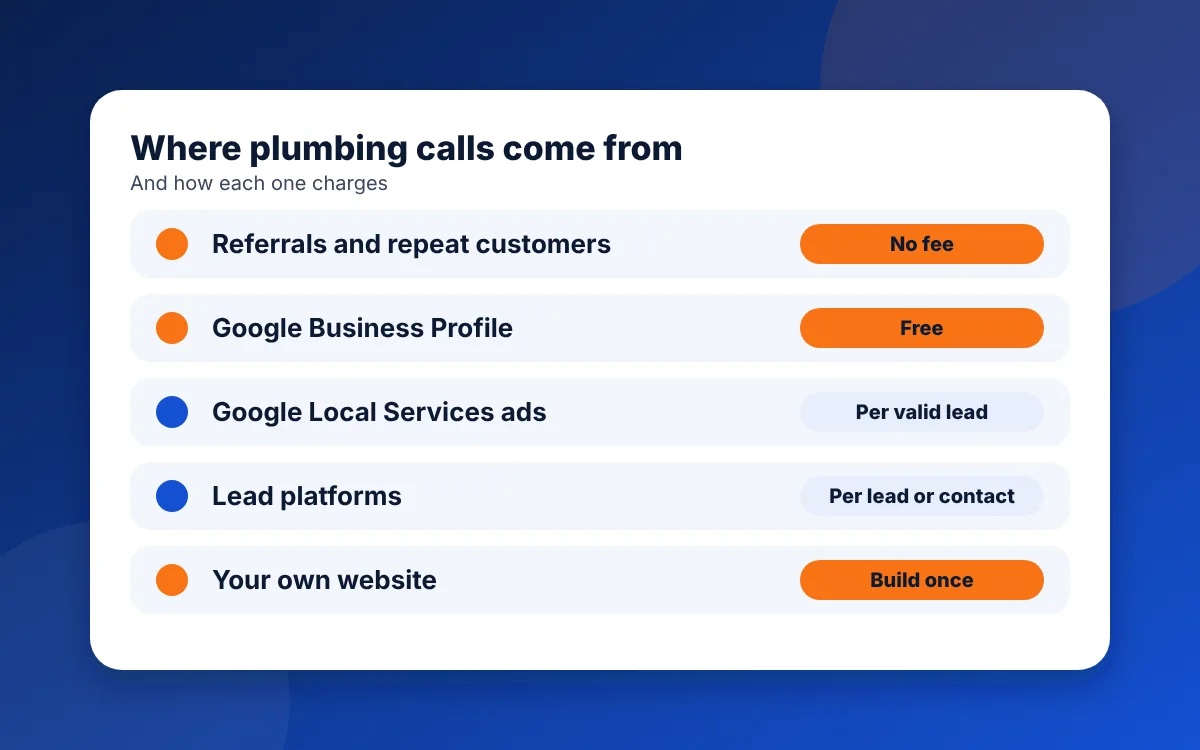
The cheapest plumbing leads come from places where the customer chooses you: referrals, and a complete Google Business Profile backed by steady reviews. Your own site, with a page for each job, supports both. Paid sources work once you know your cost per booked job. Answer every call first, then measure each source for 90 days before you add spend.
The five places plumbing leads come from
| Source | How you pay | What to check |
|---|---|---|
| Referrals and repeat customers | No fee. It costs good work and a habit of asking | Do you ask every finished customer, and do you write down who sent them? |
| Google Business Profile and the map pack | Free to set up and keep up | Services, hours, service area, photos and a steady flow of reviews |
| Google Local Services ads | Per valid lead, with the price set by location, job type and lead type | Missed calls can still be billed |
| Lead platforms (Angi, HomeAdvisor, Thumbtack) | Per lead or per contact, depending on the platform and your plan | How many other businesses got the same request, and how many you win |
| Your own website | A build cost, then no fee per call | A page for each job and town you want, with prices and proof |
Work out your cost per booked job first
The price of one lead tells you little. What matters is what you pay for each job you book. Use last quarter’s numbers for one source at a time:
- Add up what you spent on that source.
- Count the jobs you booked from it. Ask the caller, and write it down.
- Divide the spend by the jobs.
Example numbers, not data from any company: $1,500 spent and 5 jobs booked is $300 per booked job. Compare that with what an average job earns you. A source that books jobs at $300 each is fine for a $2,000 water heater replacement and a poor deal for a $150 drain clearing.
Try it with your numbers
Enter what you spent and how many jobs it booked.
Google Business Profile: fix the free source first
Google’s help page says local results are ranked mainly on relevance, distance and prominence. It describes prominence as based on “how many websites link to your business and how many reviews you have”, and it says “More reviews and positive ratings can help your business’s local ranking.” It also states: “There’s no way to request or pay for a better local ranking on Google.” Your listing in the map pack is earned, so a complete profile is the first thing to get right. Our Google Business Profile checklist covers it step by step.
Reviews matter to the person reading them as well. BrightLocal’s 2024 survey of 1,141 US consumers found that 75% always or regularly read online reviews for local businesses, that 81% use Google to read them, and that 71% would not consider a business with an average rating under three stars. It also found that 27% say reviews from the past two weeks affect their decision, which is a reason to ask for reviews all year instead of in one burst.
always or regularly read online reviews for local businesses
use Google to read them
would not consider a business rated under three stars
say reviews from the past two weeks affect their decision
Local Services ads: what Google’s own help page says
Local Services ads are the ads with the Google Guaranteed or Google Verified badge at the top of plumbing searches. Google’s help page lists the billing rules, and a few of them surprise plumbers:
- You are charged “for each valid lead”, and the price varies by location, job type, lead type and bidding mode.
- A missed call during business hours counts as a lead if the caller stays on the line for more than 20 seconds. Voicemails, texts and emails count too, and so do booking requests in the US.
- Follow-up calls and messages from the same customer are not charged again if they come within 15 days from the same phone number or email.
- When you reach your monthly maximum, your ad stops showing for the rest of the month.
- You can dispute a lead through that lead’s feedback survey, and Google may credit leads it judges low quality.
The missed-call rule matters most for plumbers, because emergency calls come at night and on weekends. If nobody answers, you can still pay for the lead. Set your ad hours to match when someone really picks up the phone.
Google does not publish average prices. Agency benchmark reports put plumbing Local Services leads at roughly $57 to $74 each in 2025 and early 2026, and non-branded Google search ads at roughly $129 to $183 per lead. Those are vendor figures from the companies that ran the accounts, so treat them as a range to test against, not a promise. Your market and how well you answer the phone will move your number.
Lead platforms: read the terms and keep score
Angi, HomeAdvisor and Thumbtack sell leads and contacts. We found no public price list from Angi, and third-party write-ups report anywhere from about $15 to $85 a lead depending on trade and city. Those write-ups also report that one request can go to several businesses. Check your own account: look at how many other businesses were sent each request, then count how many you win.
There is also a public record worth knowing. In March 2022 the Federal Trade Commission filed a complaint against HomeAdvisor alleging that it made false, misleading or unsubstantiated claims about the quality and source of its leads, and about how often leads turn into jobs. HomeAdvisor settled. The FTC approved the final order on April 21, 2023, with up to $7.2 million in redress, and the order bars the company from making false or misleading claims about its leads. The settlement does not tell you whether the leads are worth buying today. It is a reason to measure your own results instead of trusting a sales pitch. Our guide to shared leads covers how to cut back gradually.
Your own website: where plumbers lose calls
A plumber with a good profile still loses the call if the website fails the visitor. In the 20 Tulsa contractor sites we audited in October 2026 (HVAC, plumbing and roofing, so a small and mixed sample), none had a cost estimator or calculator, and 6 of the 20 showed no license or reviews on the first phone screen, where a homeowner decides whether to call. The average score was 54 out of 100. The full study lists the method and its limits.
For a plumbing site, the fixes that pay are plain. Give each job its own page: water heater replacement, drain cleaning, sewer line repair, leak detection. Put a price range and your license number on it. Add a page for each town you serve, with real local detail. Our guide to service pages shows how, and the plumbing SEO page explains what we do for plumbers. AI tools answer from the same plain facts, so the work also helps you get named in ChatGPT answers.
A 90-day plan
- Week 1 Answer or return every call, and add a line to your phone script: “How did you find us?” Write each answer in a sheet.
- Weeks 1 and 2 Complete your Google Business Profile, and ask every finished customer for a review with a direct link.
- Weeks 3 to 6 Build or fix the pages for your three most profitable jobs, with price ranges and your license number.
- Weeks 7 to 12 Add town pages. If you run Local Services ads or a lead platform, set a monthly cap and compare each source on cost per booked job.
- Day 90 Cut the source with the worst cost per booked job and move that money to the one with the best.
What these figures are, and are not
The audit counts come from Realo’s own work on 20 sites. The cost figures come from Google’s help pages and published agency reports listed below, not from Realo’s ad accounts, and they were checked on October 22, 2026. Prices and Google’s rules change, so check the current pages before you commit a budget.
Sources
- Google Business Profile Help, Improve your local ranking on Google
- Google Local Services Help, How leads work
- Federal Trade Commission, final order against HomeAdvisor, April 21, 2023
- BrightLocal, Local Consumer Review Survey 2024
- Reported cost per lead: SearchLight (via Enrich Labs and Webtonic), The Media Captain, RYN Digital and LocaliQ benchmark write-ups, 2025 and 2026. Vendor data, not independently verified.
Common questions
How much does a plumbing lead cost?
It depends on the source. Referrals and a Google Business Profile cost no fee. Agency benchmark reports put plumbing Local Services leads at roughly $57 to $74 each in 2025 and early 2026, and non-branded Google search ads at roughly $129 to $183 per lead. Those are vendor figures, so work out your own cost per booked job before you decide.
Are Google Local Services ads worth it for plumbers?
They can be, if you answer the phone. Google charges for each valid lead, and a missed call during business hours can count as one. Set a monthly cap, match your ad hours to when someone picks up, and compare the cost per booked job with what an average job earns you.
Can I pay Google to rank higher in the map pack?
No. Google's help page says there is no way to request or pay for a better local ranking. You can run Local Services ads or search ads, which are separate paid placements, but your map pack ranking comes from relevance, distance and prominence.
How do I know which lead source is working?
Ask every caller how they found you and write it down. After 90 days, divide what you spent on each source by the jobs you booked from it. Cut the source with the highest cost per booked job.
Are Angi and HomeAdvisor leads shared with other plumbers?
Write-ups by contractors and agencies report that one request can go to several businesses, but Angi does not publish the rule we could find. Check your own account to see how many others received each request and how many jobs you win.
See what is costing your plumbing business calls
The free audit shows what stops Google, Maps and AI tools from sending you calls directly, ranked by impact.
Get my free audit