
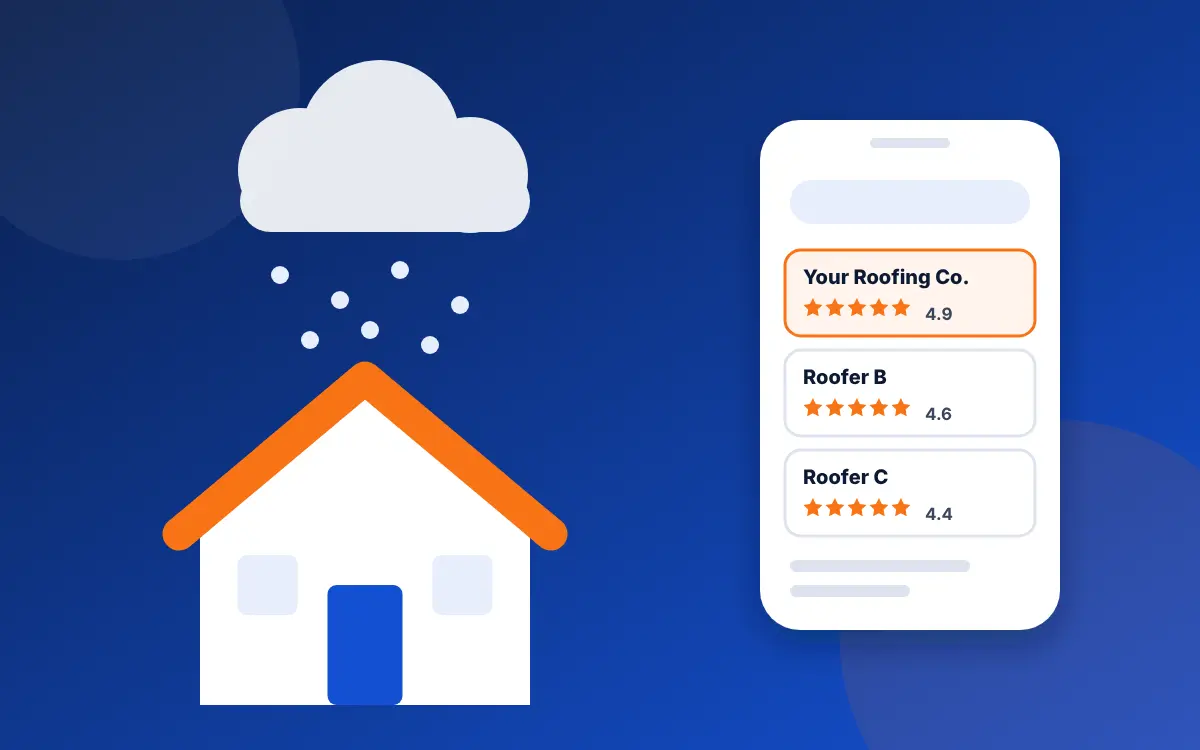
The cheapest roofing leads come from past customers, their neighbors, referral partners and a strong Google Business Profile. Paid sources such as Local Services Ads and search ads help after storms, when demand spikes. Replacement leads, where the profit is, come from pages that answer cost, insurance and repair or replace questions, and from proof on your site that you're a registered, insured local company.
Where roofing leads come from, and what each one costs
| Source | How you pay | Best time | Watch out for |
|---|---|---|---|
| Past customers and their neighbors | Your time asking, yard signs, door hangers near finished jobs | During and right after each job | Finishing a job and never telling the street |
| Referral partners | Time spent building the relationship | All year | Paying for referrals where your state or the partner's rules forbid it |
| Google Business Profile and map pack | Free | All year, strongest after storms | Wrong category, no services listed, no recent job photos |
| Local Services Ads | Per lead, price set by Google | After storms, when you have crews free | Missed calls during your listed hours can still count as leads |
| Google search ads | Per click | Replacement pushes and quiet months | Sending clicks to the home page instead of a replacement page |
| Lead platforms | Per lead, often shared | Gaps in the schedule | Competing on price with three other roofers |
| Shingle maker contractor finders | Certification requirements, not per lead | Replacement season | A listing with an old phone number or a lapsed certification |
| Your website and AI search | Build cost and upkeep, no per-call fee | Must be ready before storm season | One thin "roofing services" page for everything |
Judge every source by cost per booked job, not cost per lead. Divide last quarter's spend on one source by the number of roofs it booked. Our lead cost calculator does the math for every source at once.
Get ready before storm season, not during it
Wind and hail drive a large part of the work. According to Insurance Information Institute figures based on ISO data, wind and hail caused 42.5% of US homeowners insurance losses in 2023, and from 2019 to 2023 there were 2.8 wind and hail claims a year for every 100 insured homes. When a storm hits your area, hundreds of homeowners search at once. The roofers they find are the ones whose pages and profile were already in place.
| When | What to do |
|---|---|
| Quiet months | Write or refresh your storm damage, hail damage, insurance claim and roof replacement cost pages. Fix your Business Profile. Update your listing on shingle maker contractor finders. |
| Before your storm season | Plan Local Services Ads and search ad budgets for the weeks after a storm. Set up a fast way to book inspections by phone and text. Line up crews and materials. |
| The week after a storm | Answer every call. Post a short update on your Business Profile about the storm and how to book an inspection. Turn on paid ads only in the areas you can serve. |
| During each job | Photograph before, during and after. Ask the homeowner for a review the day you finish. Tell the neighbors you're working on the street. |
| End of the year | Count which sources booked roofs. Turn this year's finished jobs into project pages for next year. |
Adjust the timing for your region. Hail season on the plains and hurricane season on the Gulf Coast fall in different months, but the rule holds: build in the quiet weeks.
Win the trust that storm chasers can't fake
Homeowners are warned about out-of-town contractors. The Federal Trade Commission says home repair scammers "might find you after a flood, windstorm, or other natural disaster," and tells people to "check that the companies have licenses and insurance," to "get three written estimates," and not to pay by cash or wire transfer. A homeowner who has read that advice is checking you for exactly those things.
Make it easy for them. On your home page and every service page, near the top:
- Your license or registration number, with a link to the state lookup if one exists. Some states require one before you can offer roofing work at all. Oklahoma, for example, requires roofing contractors to hold a registration from the Construction Industries Board to offer or do roofing work.
- Proof of insurance, and an offer to send the certificate.
- A local address and phone number that match your Google profile.
- How long you've worked in the area, and photos of real jobs in named towns.
- Your written estimate and contract policy, plus when you take payment.
If you knock doors after a storm, this matters even more. A homeowner who looks you up on the spot should find a company that has clearly been there for years.
Get your Google Business Profile right for roofing
Google says it ranks local results on relevance, distance and prominence, and that "more reviews and positive ratings can help your business's local ranking." It also says there's no way to pay for a better local ranking. For roofers:
- Primary category: "Roofing contractor" for most companies. Add "Gutter cleaning service" or "Siding contractor" as secondary categories only if you do that work.
- Services: list roof replacement, roof repair, storm and hail damage inspection, emergency tarping, metal roofing, gutters and commercial roofing separately, with a short description of each.
- Photos: real roofs, real crews, real trucks. Add new ones every month, and a batch after every storm.
- Reviews: ask every customer, by text, the day the job is finished. BrightLocal's 2024 survey of 1,141 US consumers found that 81% use Google to read local business reviews, and 71% wouldn't consider a business rated under three stars.
The full list is in our Business Profile checklist. If your profile doesn't show up at all, start with why your business isn't showing on Google Maps.
Build pages that bring replacement leads
Repairs keep crews busy. Replacements make the year. A homeowner weighing a new roof researches first, with questions like how much a new roof costs, whether a leak means replacement, whether insurance will pay, and metal or shingles. The roofer whose page answers those questions plainly gets the call, and is more likely to be quoted in AI answers.
Pages worth writing, each on its own URL:
- Roof replacement cost in [your area]: your real price ranges by roof size and material, and what pushes the price up (tear-off layers, decking repairs, steep pitch, permits). A short table beats a paragraph.
- Repair or replace? The age, damage and leak signs you use to make the call with customers.
- Storm and hail damage: what damage looks like, why it's worth an inspection even without a leak, and how to book one.
- How insurance claims work with you: what you do and what the homeowner and adjuster do. Rules on what a contractor may do in a claim differ by state, so check yours and say plainly what you will and won't handle.
- Materials: asphalt shingles, metal and any others you install, with honest pros, cons and price differences.
- Warranties: the difference between the manufacturer's warranty and your workmanship warranty, and how long each lasts.
- Financing: who you finance through, typical terms and how to apply.
Give each page a short, direct answer at the top, then the detail. Our guide to service pages that rank shows the layout, and how to get recommended by ChatGPT covers the facts AI tools look for.
What we found on 4 Tulsa roofing websites
In October 2026 we audited the websites of 20 home service companies around Tulsa. Four of them are roofing companies. Their scores ranged from 49 to 63 out of 100. Of those 4:
- 4 had no cost estimator or calculator.
- 4 hadn't marked up their service area in the code that search engines read.
- 4 had pages asking for a quote that gave no price or price range in the text.
- 3 had no comparison table on any page, such as shingles against metal.
- 2 showed no proof of trust, such as a registration number or reviews, on the first screen of a phone.
- 2 signed their articles with a first name only, with no named author.
The common gap was the same one storm chasers exploit: homeowners couldn't quickly see a price, or any proof of who was behind the company. The full method is in the Tulsa audit study.
Use paid leads after storms, not as your only source
Local Services Ads
Roofers have their own Local Services Ads category. You pay per lead and appear at the top of roofing searches with your rating and the Google Verified badge. Google's help page on how leads work says a missed call during your business hours can count as a lead if the caller stays on the line for more than 20 seconds, and follow-up contacts from the same customer within 15 days aren't charged again. Set your ad hours to when someone answers. Google is also moving Local Services Ads into Google Ads as a pay-per-lead Performance Max campaign, starting in August 2026 for some US advertisers, so download your reports before your account moves. We compare the options in SEO vs Google Ads vs Local Services Ads.
Google search ads
LocaliQ's 2026 benchmarks put the Home and Home Improvement category at an average of $8.33 a click and $90.92 per lead. That's cheap for a full replacement and expensive for a small repair. Point replacement ads at your replacement page and run them only where your crews work.
Lead platforms
Platforms can fill gaps, but the same request can go to several roofers, and you pay either way. In 2023 the FTC finalized an order requiring HomeAdvisor to pay up to $7.2 million after alleging it misled service providers about the quality of its leads. Track your win rate per platform before spending more, and see how to get calls that are only yours.
Two lead sources roofers forget
Shingle maker contractor finders. GAF and Owens Corning both run tools that help homeowners find contractors in their programs. If you hold a certification, make sure your listing carries the same name, phone and service area as your Google profile. AI tools can check your details against listings like these.
Referral partners. Insurance agents, real estate agents and home inspectors all meet homeowners who need a roof looked at. Agree on how you'll handle their clients, follow up fast and report back. Check your state's rules and the partner's own rules before offering anything in return for referrals.
A simple weekly routine
- Ask every finished customer for a review, by text, the same day.
- Post one real job photo with a sentence to your Business Profile.
- Log where every new call came from.
- Update one page on your site: a price range, an FAQ answer, a town.
- Drop door hangers on the streets around this week's jobs.
Thirty minutes a week, every week, beats a scramble after the next storm.
Compare your lead sources in two minutes
Enter spend, leads and booked jobs for each source and see which one pays. Free, and your numbers stay in your browser.
Common questions
How do roofers get more leads?
Start with the sources that carry no fee per lead: past customers and their neighbors, referral partners and a complete Google Business Profile with steady reviews. Add pages that answer cost, insurance and repair or replace questions, then use Local Services Ads and search ads after storms. Track cost per booked job for each source.
What is the best lead source for roofing companies?
The one with the lowest cost per booked roof for your business, which you only learn by tracking every call. Referrals, neighbors of finished jobs and the Google map pack usually cost least per job once they're working, because you don't pay for each lead.
How do roofers get leads after a storm?
By being findable before it hits. Have storm damage, hail damage and insurance claim pages live, a Business Profile with recent photos and reviews, and ad budgets planned for the weeks after a storm. Then answer every call and post an update on your profile about booking inspections.
How can a local roofer stand out from storm chasers?
Show the proof homeowners are told to check. The FTC tells people to check licenses and insurance, get written estimates and avoid paying cash. Put your license or registration number, insurance, local address and real job photos near the top of every page.
Are Local Services Ads worth it for roofers?
They can be, because roofers is an eligible category and you pay per lead rather than per click. Set ad hours to when someone answers, because missed calls during your hours can count as leads. Compare cost per booked job against your other sources.
Should roofers buy leads from lead platforms?
Only to fill gaps, and only while you track your win rate. Platform leads are often sent to several roofers at once, so you compete on price and pay whether you win or not.
Sources
- Insurance Information Institute, Facts and statistics: homeowners and renters insurance (ISO data, 2019 to 2023; checked November 2, 2026)
- Federal Trade Commission, Home repair scams
- Oklahoma Construction Industries Board, Active roofing contractor requirements
- Google Business Profile Help, Tips to improve your local ranking on Google
- Google Local Services Help, Getting started with Local Services Ads
- Google Local Services Help, How leads work
- Google Ads Help, Local Services Ads transition to Performance Max campaigns with pay-per-lead goals
- LocaliQ, Search advertising benchmarks, updated June 1, 2026
- BrightLocal, Local Consumer Review Survey 2024, March 6, 2024
- Federal Trade Commission, FTC approves final order against HomeAdvisor, April 2023
- GAF, Find a residential roofing contractor; Owens Corning, Find independent roofers by state
- Realo, audit of 20 Tulsa contractor websites, October 18, 2026 (roofing subset of 4 sites)
Be the roofer they find after the next storm
The free audit shows which roofing pages, trust signals and profile settings are costing you replacement calls, ranked so you can fix the right things before storm season.
Get my free audit