
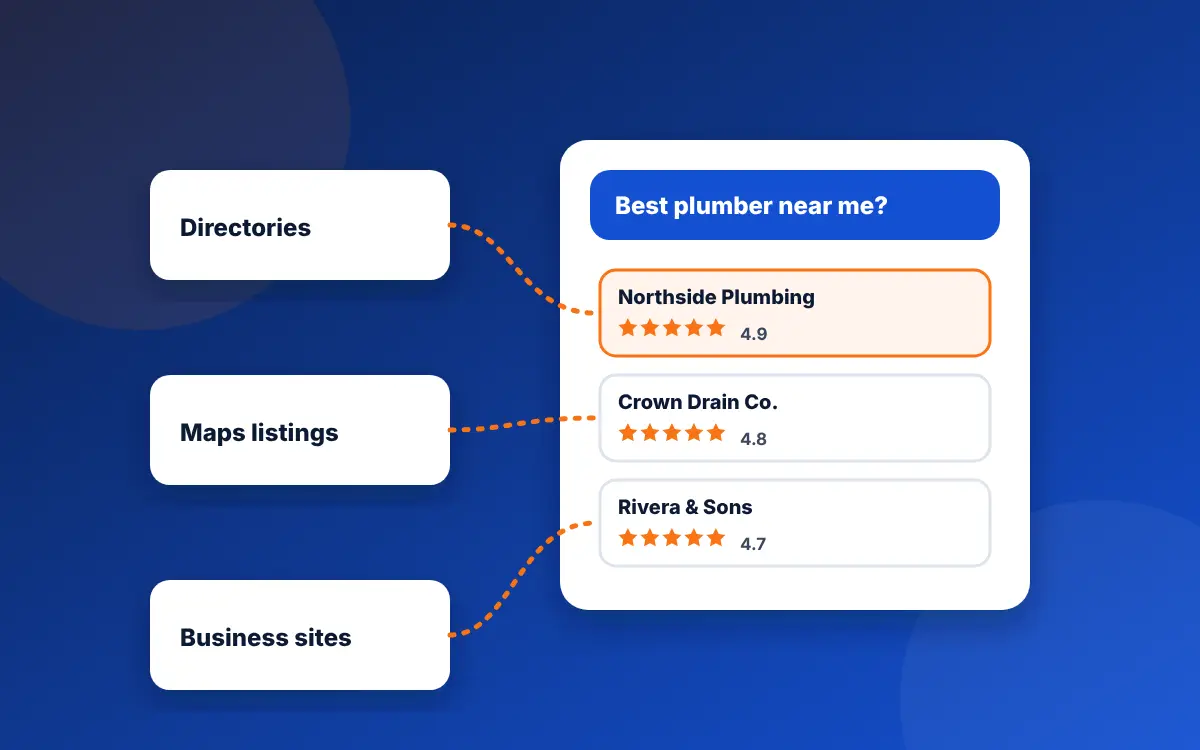
ChatGPT builds local answers from web search run through third-party search providers (OpenAI named Bing at launch), your approximate location, and pages its own crawler can read. Independent tests find it cites directories, review sites and business websites most. Nobody has shown it reads Google Business Profile directly.
What has OpenAI said about where local results come from?
Less than most business owners would like. Three things are on the record.
It uses outside search providers. When ChatGPT search launched on October 31, 2024, OpenAI's help page said the feature may share disassociated search queries with "third-party search providers such as Bing", as SiliconANGLE reported at the time. Microsoft, which builds Bing, had invested more than $13 billion in OpenAI by then, according to the same report.
It uses your location for nearby businesses. OpenAI's current help article on searching the web says ChatGPT may use an approximate location, based on your IP address, to give relevant local results. If a user chooses to share their device location, ChatGPT can use more specific information to answer questions about nearby businesses. The article doesn't say which listings feed those answers.
It runs its own search crawler. OpenAI's crawler documentation says OAI-SearchBot "is used to surface websites in search results in ChatGPT's search features", and that sites which block it "will not be shown in ChatGPT search answers", apart from plain links to the site. That one is fully in your control. If your robots.txt blocks OAI-SearchBot, your site can't be quoted. Our guide to AI crawlers and robots.txt shows how to check.
Everything beyond those three points comes from people testing ChatGPT from the outside.
Does ChatGPT use Google Business Profile?
Not directly, as far as anyone can show. OpenAI has never said it receives Google Business Profile data, and Google hasn't announced any deal to supply it. Google keeps its Maps data for its own products: its Gemini models can be grounded in Google Maps data covering more than 250 million places, according to Google's October 2025 announcement for developers.
Your Google Business Profile still matters for ChatGPT, just indirectly. The name, phone number, hours and reviews on your profile tend to get copied across the web by directories and data aggregators. If your profile is wrong, those copies are often wrong too. And Google's own AI answers, in AI Overviews, AI Mode and Gemini, do draw on Google's maps data. So a correct, complete profile is still the first listing to fix. Start with our Business Profile checklist.
Does ChatGPT use Bing for local results?
Bing is the most likely search provider behind many ChatGPT web results, based on OpenAI's launch-day wording and Microsoft's partnership with OpenAI. OpenAI hasn't confirmed which provider supplies the business cards in local answers.
The practical answer doesn't change: claim and complete your Bing Places for Business listing. It's free and controls how you appear in Bing and Bing Maps, which matters more than it sounds because Microsoft's own Copilot assistant runs on Bing search. It also takes far less work than Google, so there's little excuse to leave it unclaimed.
What do independent tests show ChatGPT cites for local searches?
Several marketing firms have run large tests. They use different questions and definitions, so their numbers don't agree, and most were run by companies that sell listing or AI visibility services. Read them as direction, not law.
| Study | What they tested | Main finding |
|---|---|---|
| Suff Digital, September 2026 | 3,160 "best [service] in [city]" questions to ChatGPT across 20 local services in 79 US cities | 95.1% of answers showed a card list of businesses, averaging about 12 names. The most cited sites were directories and review sites: Expertise.com in 28.4% of answers, Birdeye review pages in 24.5%, Angi in 21%, the BBB in 6.2%. |
| Yext, October 2025 | 6.8 million citations across ChatGPT, Gemini and Perplexity, collected July and August 2025 | 44% of citations came from businesses' own websites and 42% from listings, so 86% came from sources a business owns or manages. Forums such as Reddit made up about 2%. |
| SOCi Local Visibility Index, February 2026 | About 350,000 locations of 2,751 multi-location brands | ChatGPT recommended 1.2% of locations, Gemini 11% and Perplexity 7.4%, against 35.9% that appeared in Google's local 3-pack. |
Three lessons hold across all of them:
- Directories matter more than most owners think. Sites such as Expertise.com, Angi and Birdeye get cited because they publish "best in city" lists and reviews that answer exactly the question being asked.
- Your own website is one of the biggest sources. In Yext's data, first-party websites were the largest single group.
- Getting named is harder than ranking in the map pack. SOCi's figures suggest an AI assistant names far fewer businesses than Google's map results show, so being merely present isn't enough.
Where each AI assistant gets local business data
| Assistant | Main local data source | Listing to fix first |
|---|---|---|
| ChatGPT | Third-party search providers (Bing named at launch), OAI-SearchBot crawl, directories and review sites | Bing Places, your website, directories that rank for your trade |
| Google AI Overviews, AI Mode, Gemini | Google Search and Google Maps data | Google Business Profile |
| Microsoft Copilot | Bing search and Bing's local data | Bing Places |
| Siri and Apple Maps | Apple Maps listings | Apple Business Connect |
| Perplexity | Its own web search; local data sources not published | Your website, directories, review sites |
The pattern is simple once it's laid out. Each assistant leans on its parent company's map data, plus the open web. A contractor who only ever touched Google Business Profile is visible to one of these and fuzzy to the rest.
How does ChatGPT decide which businesses to recommend?
OpenAI hasn't published a ranking method for local recommendations, so anyone who claims to know the formula is guessing. What you can see is what the answers contain. When we wrote homeowner-style questions for our keyword research, the realistic ones were long and stacked with conditions: "Licensed electrician in Tulsa for a 200 amp panel upgrade, rough cost?" or "HVAC company in Tulsa that does heat pumps and has a maintenance plan". An assistant can only match those conditions to a business if the facts are written down somewhere it can read.
So the useful question is: if ChatGPT went looking, could it find and confirm these facts about you?
- Your exact business name, phone number and the towns you serve, the same everywhere.
- The specific services you do, each described on its own page ("heat pump installation", not just "HVAC services").
- Your license number, insurance, years in business and hours, in plain text.
- Price ranges or starting prices, where you can give them.
- Reviews on more than one site, mentioning the jobs you want more of.
- Mentions of your business on directories and local sites that ChatGPT already cites for your trade.
When we audited 20 Tulsa contractor websites in October 2026, 18 listed no prices in structured data and 19 hadn't marked up their service area with real place names. Those are exactly the facts an AI tool needs to match a stacked question, and most sites were missing them. The full study has the numbers.
What should a local business fix first?
- Let OpenAI's search crawler in. Check robots.txt for any rule blocking OAI-SearchBot. Changes can take about a day to register, OpenAI says.
- Make your Google Business Profile complete and correct. It feeds Google's AI answers directly and seeds the copies that spread elsewhere.
- Claim Bing Places and Apple Business Connect. Both are free and take under an hour each. Copy your details from Google exactly.
- Find the directories ChatGPT cites for your trade and town. Ask ChatGPT "best [your trade] in [your town]" and look at the sources it links. Then check that you're listed, correctly, on each one that accepts free listings. Be wary of directories that charge to be included in a "best of" list; the free profile is what you want.
- Write the facts on your website. One page per main service and per main town, with license, service area, hours and price ranges stated plainly. Our guide to service pages that rank shows the layout.
- Collect reviews on Google and one other site. Yelp, the BBB or a trade directory, whichever shows up when you test.
None of this guarantees a mention. ChatGPT's answers change from one run to the next, and it names only a handful of businesses per question. What the steps do is remove the reasons it can't name you.
How to check what ChatGPT says about your business
Run the test yourself once a month, and write the results down so you can see change over time.
- Open ChatGPT in a private browser window, logged out if you can, so your past chats don't sway it.
- Ask five questions a customer would ask, with your town in them: "Who's a good plumber in Owasso for a slab leak?", "Emergency electrician open now near Broken Arrow".
- Ask directly about your business: "What do you know about [business name] in [town]?" Wrong hours, an old phone number or a missing service tell you which listing to fix.
- Click the sources it shows and note which sites keep appearing.
- Repeat each question twice. If you show up once and not the second time, you're on the edge.
Do the same in Google's AI Mode and in Copilot, because each one uses different data. Our guide to getting recommended by ChatGPT covers the website side in more depth, and SEO vs GEO vs AEO explains how this fits with regular SEO.
Common questions
Does ChatGPT use Google Business Profile?
Not directly, as far as anyone can show. OpenAI has never said it receives Google Business Profile data. Your profile still matters, because directories copy its details and Google's own AI answers in AI Overviews, AI Mode and Gemini use Google's maps data.
Does ChatGPT use Bing for local results?
Partly, most likely. At launch OpenAI's help page said ChatGPT search may share queries with third-party search providers such as Bing. OpenAI hasn't confirmed which provider supplies local business cards, so claim your free Bing Places listing and keep it identical to your Google profile.
How does ChatGPT find a local business?
It searches the web through outside search providers, uses your approximate location, and reads pages crawled by its OAI-SearchBot crawler. Independent tests show its local answers lean heavily on directories and review sites, along with businesses' own websites.
How do I get my business recommended by ChatGPT?
Allow OAI-SearchBot in robots.txt, make your Google, Bing and Apple listings complete and identical, get listed on the directories ChatGPT cites for your trade, and state your services, towns, license, hours and prices plainly on your website. Nothing guarantees a mention.
Why does ChatGPT show wrong information about my business?
Usually because an old phone number, address or hours are still published on a directory or data aggregator. Ask ChatGPT what it knows about your business, click its sources and correct each listing it relies on, starting with Google, Bing and Apple.
How often should I check what ChatGPT says about my business?
Once a month is enough for most local businesses. Use the same five customer-style questions each time, in a private window, and note if you're named and which sources appear.
Sources
- OpenAI, Overview of OpenAI crawlers (checked October 29, 2026)
- OpenAI Help Center, Searching the web with ChatGPT
- SiliconANGLE, OpenAI adds large language model-powered search engine to ChatGPT, October 31, 2024
- Google, Grounding with Google Maps: now available in the Gemini API, October 17, 2025
- Suff Digital, ChatGPT local answers study, September 24, 2026
- Yext, 86% of AI citations come from brand-managed sources, October 9, 2025
- SOCi, 2026 Local Visibility Index, February 2026
- Realo, audit of 20 Tulsa contractor websites, October 18, 2026
Is AI sending your calls to someone else?
The free audit checks whether AI crawlers can reach your site and whether your services, towns, prices and license are written where an assistant can find them.
Get my free audit